
An HRT review is not just about renewing your prescription. It’s an opportunity for a holistic conversation about your menopause and longer-term health. HRT can be transformative for many people, but finding the right regime is not necessarily a one-off process. As your symptoms, health, medications and lifestyle change, your HRT may need to evolve too. An HRT review is therefore a valuable opportunity to step back and reflect on whether your current HRT is working well, and still the best option for you.
Whether you have recently started HRT or have been using it for some time, a review can help make sure your treatment remains effective, practical and appropriate for your current circumstances. NHS guidance recommends a review around three months after starting or changing HRT, followed by an annual review when treatment is established.

Your health can change — and so can your HRT needs
An HRT review is not just about your menopause symptoms. It is also an opportunity to look at your health as a whole. Have you developed any new medical conditions? Have you started taking new medication? For example, if you have started a new medication such as Mounjaro (tirzepatide), it may be appropriate to reconsider how your HRT is being administered.
The aim is to make sure your HRT continues to fit the person you are now, rather than simply continuing the same prescription because it has always been prescribed that way.
Is your HRT dose still right for you?
Are your symptoms largely well controlled? Have any symptoms returned or changed? Are you experiencing symptoms that were not present when you first started HRT?
Your dose and the type of HRT you are using may need reviewing. Finding the right dose is about achieving good symptom control while taking into account your individual history.
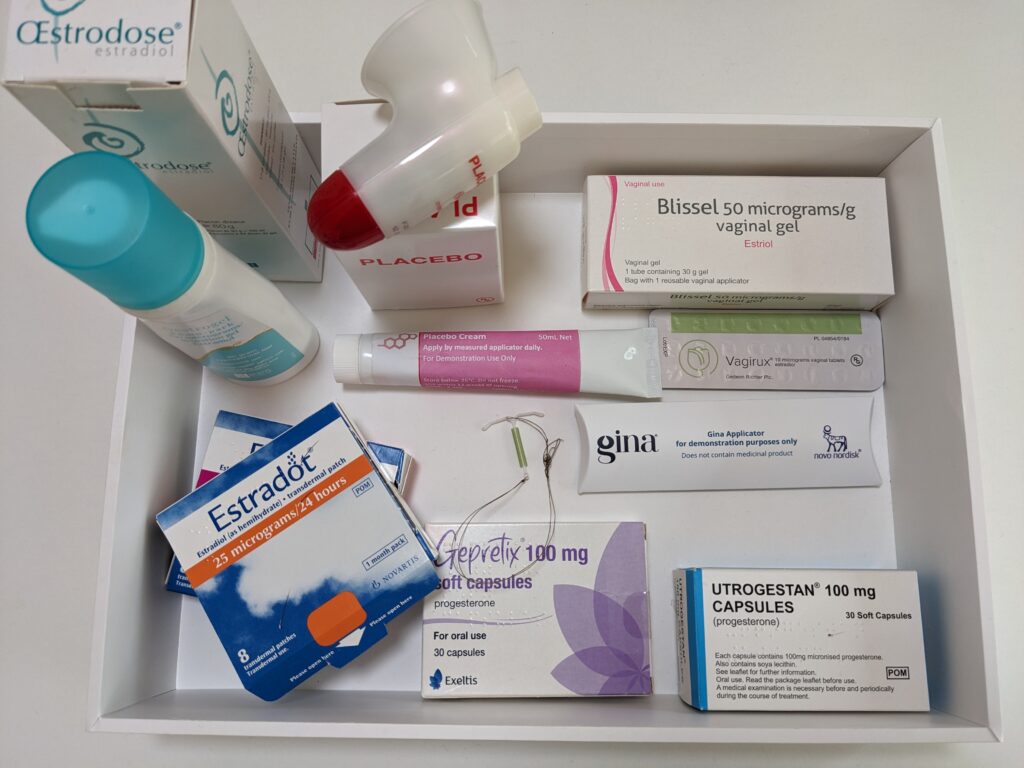
What symptoms are you still experiencing?
An HRT review is a chance to look beyond the symptoms you initially wanted to treat.
You may find that hot flushes and night sweats have improved, but brain fog, joint pain, or urinary symptoms remain troublesome.
It can be helpful to discuss each symptom individually. Sometimes the answer is a change to your systemic HRT; sometimes another approach is more appropriate.
Does your HRT fit into your life?
The best HRT regime is not necessarily the one that looks best on paper, or the one your friend uses, it is one that works for you and fits into your daily life.
If you use gel, are you comfortable applying it every day? Do you know how and where it’s best applied? Are you allowing it to dry properly? If you use patches, are they staying in place? If you take tablets, are you remembering them consistently? Details like this can make a surprising difference to effectiveness.

An HRT review is a good time to talk through these practicalities rather than assuming that difficulties with treatment are simply something you have to put up with. It’s quite safe to try a different preparation, to see if that may suit you better.
Are you experiencing any side effects?
HRT can cause side effects, particularly when treatment is first started or changed. These side-effects can include breast tenderness and bloating. Side effects often improve over time, but persistent or troublesome symptoms should be discussed with your healthcare professional. Sometimes a relatively small change in dose, preparation or the type of HRT can make a significant difference.
Bleeding patterns should also be reviewed. Changes in bleeding can be expected with some HRT regimes, particularly during the first three months, but unscheduled, heavy or persistent bleeding should always be assessed.
Is it time to move across to continuous combined HRT?
Your HRT needs change as you move through the menopause. If HRT is started in the perimenopause generally sequential (cyclical) HRT is used, where the oestrogen is used every day and the progesterone for 2 weeks out of 4. Over time, this is changed to continuous combined HRT, where both hormones are used every day. Continuous combined HRT is a “bleed-free” type of HRT.
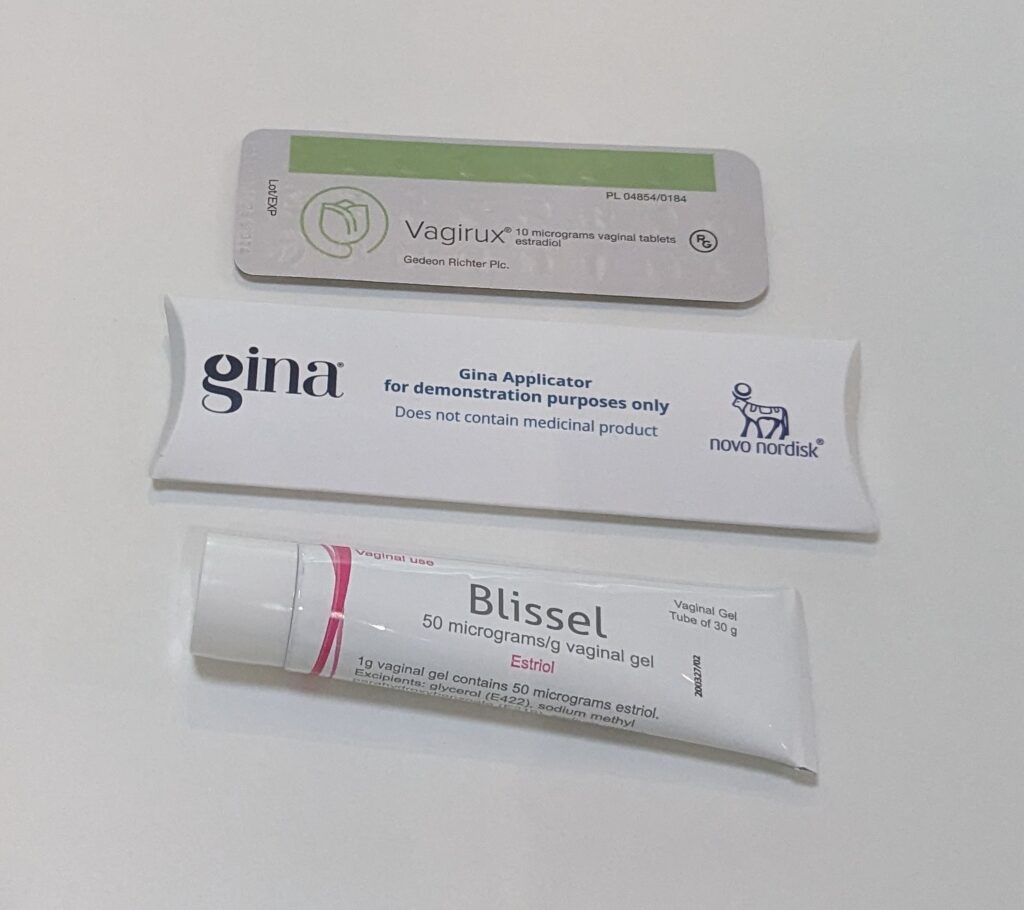
Would you benefit from local oestrogen?
Systemic HRT may improve many menopause symptoms, but vaginal and urinary symptoms can sometimes persist.
If you are experiencing vaginal dryness, irritation, discomfort during sex or urinary symptoms, it is worth raising these at your review. Local (vaginal) oestrogen can be used alongside general (systemic) HRT when appropriate and can make a considerable difference. NICE recommends continuing vaginal oestrogen for as long as needed to control symptoms.
Is testosterone worth trialling?
Not everyone needs to add in testosterone, but it can certainly help many people with ongoing low sexual desire despite general (systemic) HRT being optimised. It’s important to talk through the benefits and risks with your healthcare professional, and see if this is something that may benefit you.
Don’t forget supplements and lifestyle
An HRT review can be much broader than a medication review.
It may be useful to review any vitamins or supplements you are taking and consider whether they are necessary, beneficial or potentially interacting with other medicines. There may be others your healthcare professional will recommend adding in, depending on your symptoms and medical history.
Additional tests may also be appropriate. For example, if you are plant-based and have symptoms such as persistent fatigue, a clinician may consider whether checking levels such as active vitamin B12 is appropriate. If you have a strong family history of osteoporosis, a DEXA scan may be useful.
Lifestyle is another important part of the conversation. Menopause is an opportunity to look at the bigger picture: sleep, nutrition, movement, rest and connection can all contribute significantly to longer-term health.
An HRT review is about more than your prescription
Perhaps the most important thing to remember is that an HRT review should be a conversation, not simply a medication check. Your treatment should be reviewed in the context of your current symptoms, current health, other medications, preferences and priorities.
You do not necessarily need to stay on the same HRT preparation or dose indefinitely. Equally, there is no arbitrary time limit that means HRT must automatically be stopped; the decision to continue treatment should take account of your individual health and priorities. If something isn’t working, please say so. If your circumstances have changed, talk about it. And if your HRT is working brilliantly, that is useful information too!
The goal of an HRT review is simple: to make sure your treatment continues to work for you — not just the version of you who started it. Here at Rethink HRT reviews include a comprehensive conversation with Sam, covering all of these aspects, and include email follow-up after consultations.